The Water Cycle Is Not a Neat Loop
The water cycle is not a neat loop. Learn to read its arrows, follow branching routes through soil and streams, and spot what a diagram leaves out.
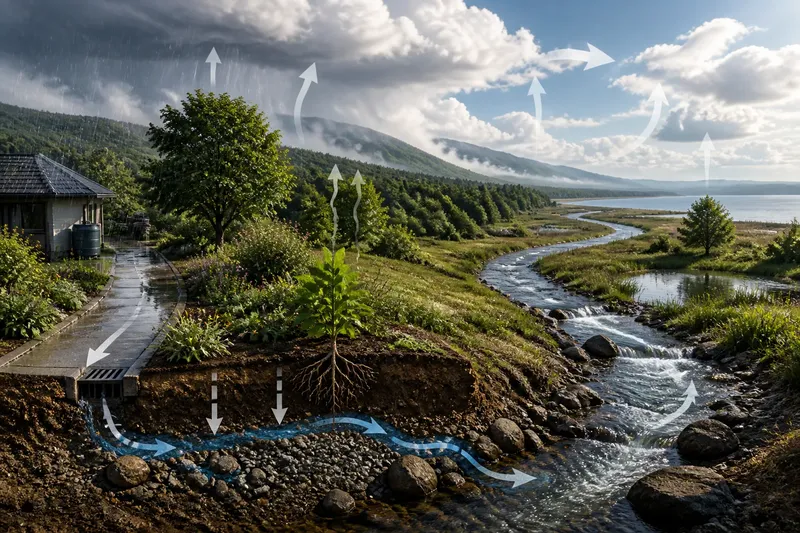
The most common mistake in reading a water cycle diagram is treating its arrows as one fixed circuit. That can hide the choices a raindrop faces when it lands: soak into soil, gather on a surface or return to the air. To read the water cycle, start with a particular store of water and follow the transfers that could take it elsewhere.
Start with a water store
A diagram may place the ocean at the bottom, clouds above it and arrows between them. This layout can suggest that every journey starts at sea. In fact, water is held in many stores, including oceans, lakes, rivers, soil, rock, ice, plants and the atmosphere.
Choose one store, then ask what processes can move water out of it and where it might go next. An arrow marks a possible transfer, not a timetable or a route every drop must follow.
Say rain falls on a garden after a dry spell. One drop could enter the soil, be taken up by a plant and later leave a leaf as vapour. A nearby drop could run from a paved path into a drain and then a creek. The different surfaces give the water different routes.
Clouds are temporary stores
A cloud is not the start of every water journey. It is a temporary store of tiny droplets or ice crystals. Water reaches the atmosphere from the sea, lakes, wet ground and plants.
Evaporation transfers liquid water into the air as vapour. Transpiration is water vapour released by plants, mainly through their leaves. Moisture moves with the air and mixes; some later condenses into clouds, while some stays in the atmosphere.
If an arrow appears to jump from a lake to a cloud, read it as a simplified transfer. Water evaporates from the lake, travels through the atmosphere and may condense. The picture does not imply that vapour rises straight up or returns directly to its source.
Surfaces split rain routes
Rain can raise one stream quickly and produce little visible flow elsewhere. Different surfaces absorb, store or redirect water, so rainfall does not have the same immediate effect everywhere.
On permeable ground, water can enter the soil, move deeper or feed groundwater. On compacted ground, rock, roofs and paved streets, more may flow over the surface. Vegetation can catch rain before it reaches the ground and later release some moisture to the air.
Look for separate arrows labelled infiltration, surface runoff and groundwater flow. They show distinct routes. Groundwater can move through soil or rock, then emerge at a spring, enter a wetland or contribute to a river. Runoff may reach a channel sooner, but it can first collect in a hollow or pond.
Imagine rain falling on a sloping park with a compacted footpath beside a planted border. Water running off the path could gather at the border, while rain on the planting bed could enter the soil. You would expect more immediate surface flow from the path and more water held below ground in the bed; neither observation alone reveals what happens next.
Rivers are not endpoints
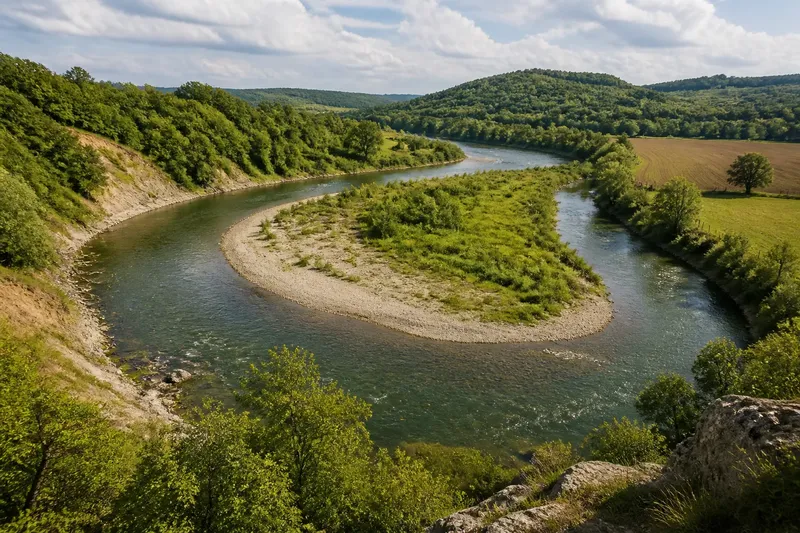
A river is a route and a store, not the cycle’s final destination. Channel water can flow downstream to a lake, estuary or sea, seep into the bed, evaporate or be taken up by plants along the banks.
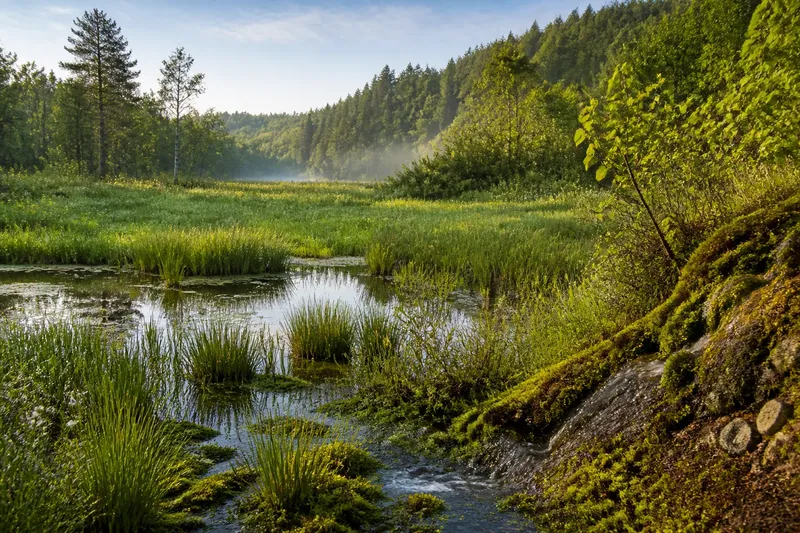
These transfers can connect. Water seeping from a stream may travel through nearby ground and return farther downstream. Water in a wetland may spread across shallow ground, enter a channel later or evaporate. The visible river shows only the water in its channel at that moment, not every exchange with banks, soil and air.
If a diagram seems to stop at a river, look for arrows showing discharge to a larger body of water, infiltration into the bed, evaporation or storage in a lake or wetland. If those arrows are absent, the drawing may simply show a limited part of the cycle.
Common water cycle questions?
Does all rain reach a river?
No. Rain can return to the atmosphere, enter soil, remain in a lake or wetland, or be taken up by plants. Its route depends on the surfaces, stores and connections in the area.
Can water move from the ground to the air?
Yes. Water can evaporate from moist soil and open water. Plants also release water vapour through transpiration, connecting land and waterways to the atmosphere.
Does groundwater always flow into a stream?
No. Groundwater may move towards a spring, wetland, lake, coast or another part of the subsurface. Its direction depends on local geology and conditions.
Why do water cycle diagrams use arrows?
Arrows make transfers visible, but reduce a changing system to a flat picture. Read each one as a possible connection, then check which stores and routes the diagram leaves out.
Read diagram gaps
A diagram has to leave things out. An arrow labelled “precipitation” may cover rain or snow falling on very different surfaces. A broad arrow between land and air may combine evaporation and transpiration. Missing detail is a cue to ask what has been simplified, not to assume one route applies everywhere.
Try following two paths from the same store. From rain on land, trace one path through soil and groundwater to a spring, then into a stream. Trace another from wet leaves through transpiration to the air, then onward as atmospheric moisture. Comparing them makes branching and storage easier to see than following a single circular arrow.
For a local investigation, choose one feature that can be checked on foot, such as where a stream passes beneath a road or enters a pond. Note what is visible at that point, then ask which upstream or underground connections the diagram cannot confirm. This keeps the question tied to an observable place without treating a picture as a complete account.
Follow the water cycle
The water cycle is not a neat loop: water can leave stores by different routes, pause in them and branch towards several destinations. When an arrow seems too simple, name the store it starts from, the transfer it represents and the possible next stores. That habit helps you follow water through air, ground and waterways without forcing it into a single circuit.
One useful question remains: what does the diagram not show? It may omit groundwater, plant activity, temporary storage or movement through the atmosphere. Recognising those limits helps you treat the water cycle as a set of connected routes rather than a picture that dictates where water must go.